 Sport Break News
How shirt numbers became a map of football's tactical history
Guardian Football's Jonathan Wilson traces how shirt numbers evolved from rigid positional markers into tributes for the game's greatest and most tragic figures.
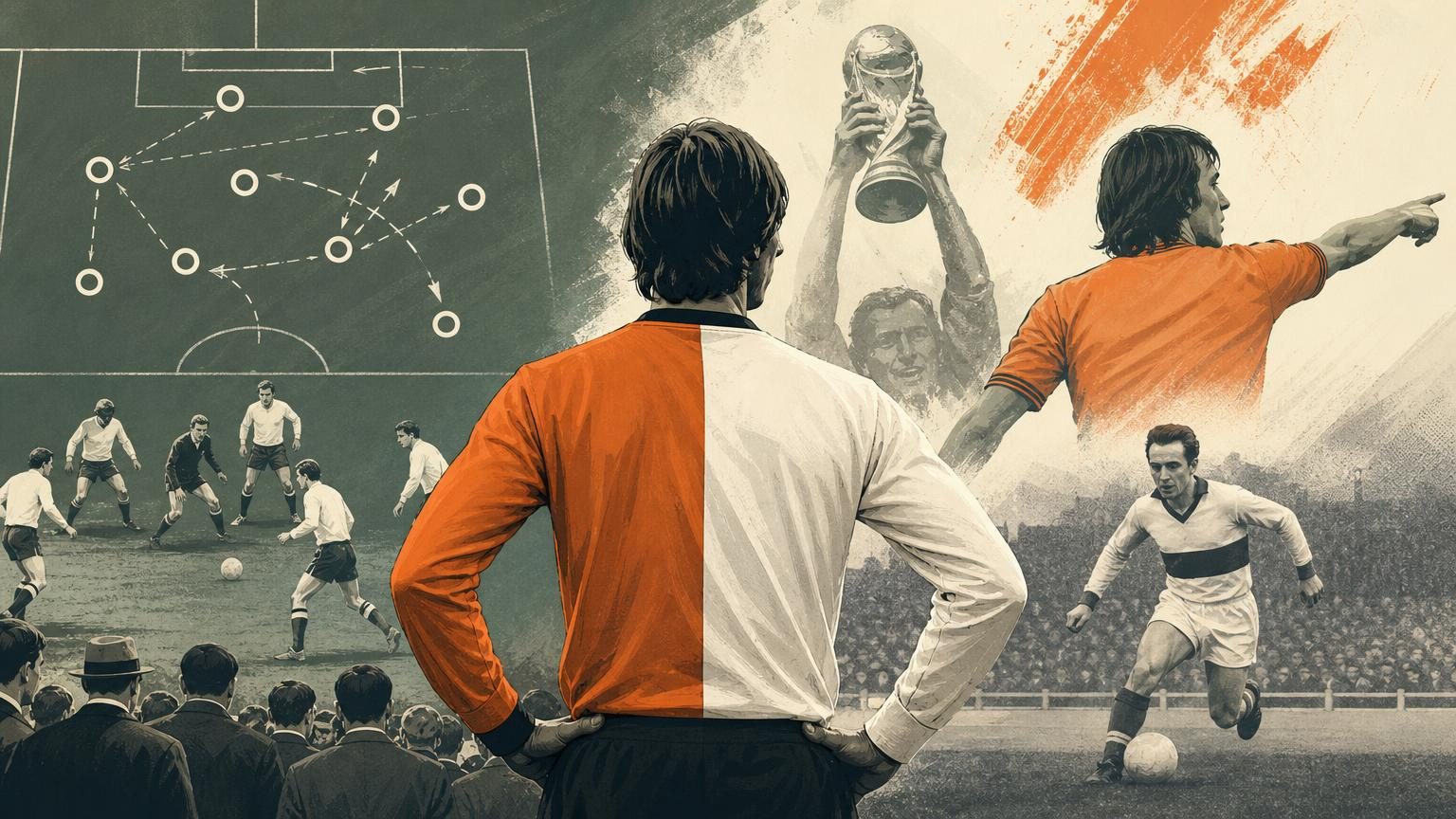
Shirt numbers carry weight far beyond identification, according to reporting by Guardian Football's Jonathan Wilson, who argues that the digits clubs choose to retire, and the positions those numbers once denoted, chart football's tactical history as clearly as any textbook.
Several clubs have withdrawn numbers to honour individual greatness. Ajax retired the No 14 for Johan Cruyff, while Milan did the same with No 3 for Paolo Maldini and No 6 for Franco Baresi. Birmingham retired the No 22 for Jude Bellingham. Others have retired numbers following premature deaths, among them Liverpool's No 20 for Diogo Jota, Manchester City's No 23 for Marc-Vivian Foé and Espanyol's No 21 for Daniel Jarque.
Before squad numbers existed, according to the Guardian Football report, the digit on a player's back was purely positional, with expectations attached to each number that varied by country and era.
The earliest known instance of numbered shirts in football dates to a 1911 match between Sydney Leichhardt and HSM Powerful, the piece notes, with sporadic experiments following in the American Soccer League from 1923 and in various touring sides through that decade. English football's first taste came in August 1928, when Chelsea wore 2-11 against Swansea and Sheffield Wednesday wore 1-11 opposite an Arsenal side numbered 12-22 at Hillsborough.
It took until June 1939 for the Football League to formally adopt squad numbers, voting 24-20 to have both teams wear 1-11 in a fixed order based on the old 2-3-5 formation, even though most sides had by then switched to the W-M system. That mismatch meant the goalkeeper's No 1 through to the left-winger's No 11 described a shape that bore little resemblance to how teams actually set up on the pitch.
The rigidity of those numerical expectations was exposed brutally when Hungary visited Wembley in 1953 and became the first foreign team to beat England there. Hungary's numbering baffled English observers: centre-back Mihaly Lantos wore No 4, midfield creator Jozsef Bozsik wore No 5, and Nandor Hidegkuti, nominally the No 9 centre-forward, instead operated from midfield. England's centre-half, Harry Johnston, had no obvious way to track him without abandoning his defensive line.
That defeat, Wilson writes, pushed English football towards a back four within a decade, typically achieved by dropping the left-half into defence. Alf Ramsey's 1966 World Cup winners then demonstrated the value of a crowded midfield, pulling the wingers deeper to form what became a recognisable 4-4-2, with the No 10 retaining the inside-left's creative licence alongside a more physical No 9.
Argentina followed an entirely different path. At River Plate in the late 1930s, right-half Norberto Yácono, nicknamed the Stamp for his man-marking, set a precedent that made Argentina's No 4 a de facto right-back role — a lineage that runs through to Javier Zanetti, whose shirt Inter later retired. After Argentina's 6-1 defeat to Czechoslovakia at the 1958 World Cup, the side adopted a back four, with the left-half dropping in to complete the line and the No 5 surviving as midfield's leader, embodied over the decades by Antonio Rattín, Américo Gallego and Javier Mascherano.
The contrast between English and Argentinian numbering systems, as Wilson's reporting lays out, reflects two countries solving the same tactical problem — defending against the W-M and its successors — by moving different pieces into the back line, leaving a numerical fingerprint that persists in how certain shirts are still regarded today.